Oven Repair
Oven Smells Like a Gas Leak? The First Minute, Then the Causes
If your oven smells like a gas leak, with a sulfur or rotten-egg odor that lingers, leave the house without touching switches and call the gas utility from outside. A faint puff as a gas oven lights can be normal; a smell that stays is not.
- Written by
- Hollis Yamada
- Specialism
- Service technician — refrigeration and cooking
- Years in practice
- 21
- Holds
- EPA Section 608 certified
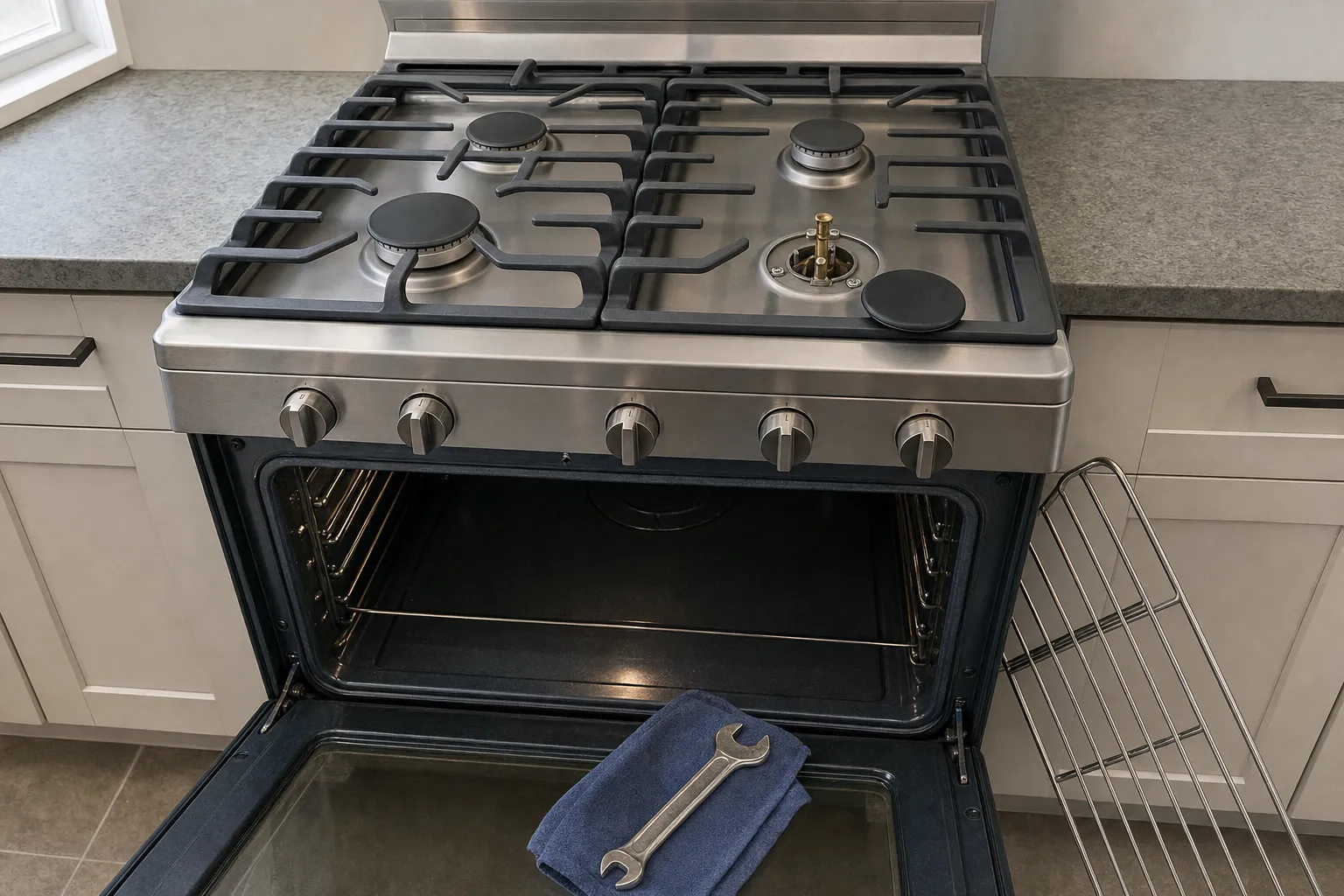
If your oven smells like a gas leak, meaning a sharp sulfur or rotten-egg odor that is strong, keeps building, or hangs around after the burner is lit, treat it as a real leak. Do not flip a light, start the hood fan or strike a match; lead everyone outside, and only when you are a safe distance from the house make the call to the gas utility or 911. The one gas smell that can be ordinary is a faint puff in the second or two before a gas oven catches, and it fades as soon as the flame settles. Edmonds kitchens spend much of a damp Puget Sound winter with the windows shut, so odors hang about longer than they would in July, and it pays to know which smell is which.
The first minute matters more than the cause
Fuel leaks inside a home are uncommon, but the response has to be automatic, because the danger comes from a spark you make while you are still deciding what the smell is. The guidance from NFPA comes down to a short list:
- Walk out at once and take people and pets with you.
- Put out an open flame, such as a candle or a lit burner, only if it is right on your way out.
- Leave lights, appliances and the thermostat exactly as they are, and do not unplug the range.
- Make no calls from inside the house, and that includes a mobile phone.
- From outside, at a good distance, call 911 or the gas utility’s emergency line. In Edmonds that utility is Puget Sound Energy.
Do not stay behind to hunt for the source. The utility crew carries detectors that find a leak far faster than a nose can, and they will say when it is safe to go back in. An appliance repair visit only makes sense after that.
Smells that are not gas, and how to tell them apart
Most oven odors that alarm people are heat smells, not fuel. Natural gas and propane have no scent of their own; suppliers blend in an odorant called mercaptan so that a leak smells of sulfur, boiled cabbage or rotten eggs. Heat smells read differently: acrid, smoky, or faintly chemical.
| What you notice | Likely cause | What to do |
|---|---|---|
| Hot, chemical smell during the first few uses of a new oven | Manufacturing oils and insulation binders burning off | Run it empty on a high setting with a window open |
| Smoke or a burnt-sugar smell | A spill on the oven floor | Let it cool, then clean the cavity |
| Strong burnt odor during a clean cycle | Baked-on soil being reduced to ash | Ventilate; it ends with the cycle |
| Sulfur or rotten-egg odor that lingers | Possible fuel leak | Leave and call from outside |
Self-clean produces the loudest of these. Viking’s self-cleaning ovens climb to as much as 750°F, and the cycle generally runs 3 to 3½ hours depending on the model, followed by roughly 30 minutes of cooling. Thick grease left in the cavity can smoke and stink for that whole stretch, so scrape out the worst of it beforehand; our note on the porcelain oven interior explains which cleaners the enamel will tolerate.
If your Viking is an electric wall oven, it has no gas supply at all, so a fuel smell near it is coming from something else in the house, such as a gas cooktop, the furnace or the water heater. Leave and call all the same.
When the lighting smell becomes a warning
Gas range ovens light their bake burner with an igniter. Viking’s 5 Series gas range ovens, for instance, pair one 30,000 BTU U-shaped bake burner with a Gourmet-Glo infrared broiler, and the SureSpark ignition system lights both. Because a little gas reaches the burner just ahead of the flame, a brief whiff at the moment of lighting is not a fault.
These signs are a fault:
- A pause of several seconds before the flame shows, then a soft whoomp as it catches. Gas pooled before it lit, which usually points to an ignition part that is weakening.
- The smell carrying on after the burner has a steady flame.
- Any odor while the oven and every burner are switched off.
- Yellow, lazy or lifting flames in place of a crisp blue one.
Late ignition is the most common of these, and it is a genuine repair rather than a quirk; our page on how gas oven igniters glow and age describes the symptoms in more detail. Stop baking until it has been checked.
A rangetop knob nudged slightly open is another frequent culprit. On 5 Series ranges, the surface burners relight on their own if the flame goes out while gas is still flowing. Silence matters too: a knob that produces no clicking should go straight back to off, and the next things to look at are the plug behind the range and the breaker panel, since a range with no power has nothing to light the gas.
Why your nose is a poor alarm
Smell works well for the first moment and badly after that. NFPA points out that after a minute or two in the same air, people can stop noticing the mercaptan entirely, an effect called olfactory fatigue. That is why someone coming home from errands smells something the person at the stove has stopped registering.
A fuel gas alarm closes that gap. NFPA 715 places these alarms near fuel-burning appliances and outside sleeping rooms, and they are designed to sound at or below 10 percent of the lower explosive limit, long before the air could ignite. A carbon monoxide alarm is a different device and will not warn you about natural gas.
What a repair visit checks
Once the utility has cleared the house, or when the only complaint is slow lighting, a technician works through the oven and its supply:
- Connector and shutoff. The flexible connector, its fittings and the valve behind the range are leak-tested with bubble solution or an electronic sniffer. A range that was pulled out for cleaning and shoved back can kink or strain that connector.
- Ignition. How quickly the burner lights, and whether the igniter and the oven safety valve test within range electrically.
- Burner and flame. Flame color and shape, the orifice, and how the burner sits.
- Fuel type. Whether the range is set up for the gas it actually burns, since running LP through natural-gas orifices, or the reverse, gives a poor flame and a smell.
A leak in the house piping upstream of the appliance shutoff is a job for the utility or a gas fitter, not an appliance technician.
What the repair is likely to cost
When the utility finds no supply leak, most of these calls end in an ignition repair. A new igniter or burner assembly typically runs $190–$410, with the firm figure given once the fault is diagnosed. The $89 diagnostic visit is a single charge covering the trip and the whole fault-finding, and every dollar of it comes off the bill if you approve the work. For a closer look at that number, read what a Viking oven igniter replacement costs. Homeowners in Downtown Edmonds, Westgate, Perrinville and Five Corners can reach us at (206) 210-3547.
Asked about this note
- Do gas ovens smell like gas when you turn them on?
- A gas oven can give off a brief, faint gas smell in the second before the bake burner lights, and that is normal. The odor should vanish once the flame is steady. If it lingers, grows stronger, or arrives with a delayed whoomp at ignition, stop using the oven and call Viking Appliance Repair Edmonds at (206) 210-3547.
- What does a gas leak smell like compared with a burning oven?
- Leaking fuel gas smells of sulfur or rotten eggs because of the odorant blended into it, while an oven burning off residue smells smoky, acrid or chemical. If you honestly cannot tell which one you have, treat it as gas, go outside, and call the utility or 911 from there. Book Viking Appliance Repair Edmonds only after the utility clears the house.
- Why did the gas smell seem to fade after a few minutes?
- Your nose has probably stopped registering it. NFPA warns that olfactory fatigue can blunt your sense of the odorant within a minute or two, so a fading smell is no proof the leak has stopped. Believe whoever walks in fresh from outside, and consider a fuel gas alarm near the kitchen; questions about the oven itself can go to (206) 210-3547.
- Can I convert my Viking range from natural gas to propane myself?
- No, that conversion belongs with a qualified installer or technician. Viking 5 Series gas ranges ship set up for either natural gas or LP, and switching one in the field calls for the optional LPKPDR01 kit plus gas work a homeowner should leave alone. A mismatched setup can cause poor flames and odor, so call (206) 210-3547 if you are unsure.